

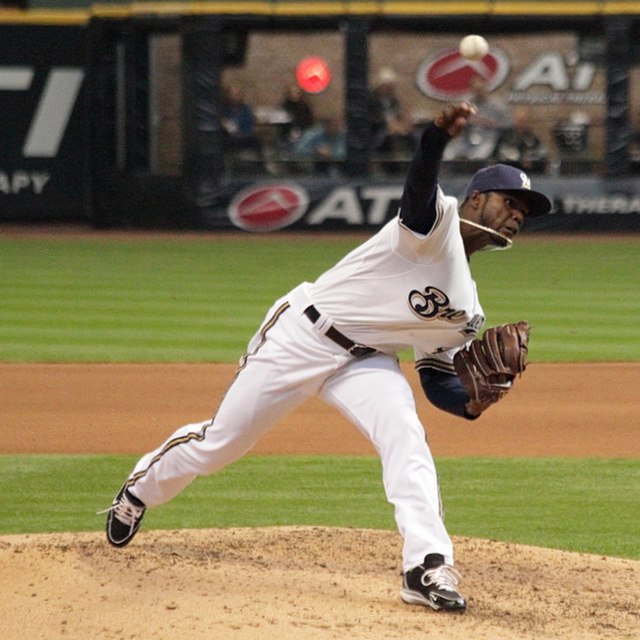
In the lush, coastal province of Samaná, Dominican Republic, baseball is more than just a pastime—it is a heartbeat. For many young athletes growing up on the island, the baseball diamond represents a field of dreams and a ticket to a wider world. Few players embody this global pursuit quite like Alfredo Fígaro.
While some players spend their entire careers in one uniform, Fígaro’s path has been that of a true baseball nomad. His journey has taken him from the tropical academies of the Caribbean to the historic ballparks of the American Midwest, and across the Pacific to the stadiums of Japan, South Korea, and Taiwan.
This post explores the fascinating career of Alfredo Fígaro. We will look at his rise to Major League Baseball (MLB), his adventures in international leagues, and the legacy he leaves for aspiring pitchers in his hometown of Samaná.
Roots in Samaná: The Early Days
Born on July 7, 1984, in Samaná, Alfredo Fígaro grew up in a region known as much for its breathtaking humpback whales as for its athletes. However, the Dominican Republic produces baseball talent at an industrial scale, and Fígaro was determined to be part of that export.
His path to professional baseball wasn’t instant. He first signed with the Los Angeles Dodgers organization in June 2004 as an amateur free agent. However, that initial stint was short-lived, and he was released later that year. For many, this could have been the end of the road. Instead, it was just a speed bump.
Fígaro persisted, honing his craft and maintaining his velocity. His resilience paid off when the Detroit Tigers signed him as a minor league free agent in March 2005. This marked the true beginning of his ascent. He worked his way through the Tigers’ farm system, showing promise in the Dominican Summer League and eventually making waves in the US minor leagues. By 2008, he was turning heads with the West Michigan Whitecaps, leading the Midwest League with an impressive ERA and showcasing the arm talent that would soon take him to “The Show.”
The MLB Dream: Detroit and Milwaukee
Every minor leaguer dreams of the call-up. For Fígaro, that call came in June 2009.
The Detroit Tigers Years (2009–2010)
Fígaro made his Major League debut on June 20, 2009, against the Milwaukee Brewers—ironically, a team he would later play for. It was a memorable start. He stepped into the rotation to replace an injured Dontrelle Willis and delivered a solid performance, earning the win. He pitched five innings, allowing two runs and striking out seven batters.
During his time with Detroit, Fígaro oscillated between the starting rotation and the bullpen. He possessed a lively fastball and a serviceable breaking ball, tools that kept him in the mix for a roster spot. Over two seasons with the Tigers, he appeared in 13 games. While his ERA hovered above 6.00 during this learning curve, the experience of pitching against the world’s best hitters was invaluable.
A New Home with the Brewers (2013–2014)
After a stint overseas, Fígaro returned to the United States with the Milwaukee Brewers in 2013. This period arguably marked his most consistent stretch in the majors. He made the Opening Day roster as a non-roster invitee, a testament to a stellar spring training performance.
In 2013, he proved his versatility. The Brewers used him as a “swingman”—a pitcher capable of both starting games and pitching long relief innings. He appeared in 33 games that season, posting a 3-3 record with a respectable 4.14 ERA. He logged 74 innings, providing stability to the Brewers’ pitching staff and earning his first MLB save.
The Global Traveler: Success in Asia
One of the most defining aspects of Fígaro’s career is his willingness to embrace baseball on a global scale. When opportunities in the U.S. fluctuated, Fígaro took his talents to Asia, proving that a quality arm is valuable in any language.
Nippon Professional Baseball (Japan)
Between his stints with the Tigers and the Brewers, Fígaro signed with the Orix Buffaloes of Japan’s Nippon Professional Baseball (NPB) league. He played there in 2011 and 2012. Japanese baseball is known for its precision, discipline, and distinct style of play, which prioritizes contact and small ball.
Fígaro adapted well. In 2012, he posted a solid 3.31 ERA over 127 innings. This success in a high-level league was crucial. It kept him on the radar of MLB scouts and directly led to his contract with Milwaukee the following year.
The KBO League (South Korea)
After his time with the Brewers concluded, Fígaro moved to the KBO League in South Korea, signing with the Samsung Lions for the 2015 season. The KBO is famous for its passionate fans and high-scoring games, often presenting a tough environment for pitchers.
Fígaro thrived. He became a workhorse for the Lions, winning 13 games and losing only 7. He posted a 3.38 ERA and struck out 117 batters. His performance helped the Samsung Lions remain competitive and solidified his reputation as a reliable international ace.
Chinese Professional Baseball League (Taiwan)
The journey didn’t stop in Korea. In 2017, Fígaro joined the Uni-President 7-Eleven Lions in Taiwan’s CPBL. By playing in the top leagues of three different Asian nations, Fígaro joined a unique fraternity of international baseball travelers. It demonstrated not just physical durability, but mental toughness—adapting to new cultures, foods, time zones, and strike zones is a challenge that defeats many athletes.
By The Numbers: A Career Overview
Alfredo Fígaro’s career statistics reflect a pitcher who battled through different roles and leagues to stay in the game.
Major League Baseball (MLB) Totals:
- Win-Loss Record: 5–8
- ERA: 5.04
- Innings Pitched: 114.1
- Strikeouts: 83
- WHIP: 1.43
While his MLB numbers might suggest a journeyman reliever, they don’t tell the full story. When you combine his statistics from the NPB, KBO, and CPBL, you see a pitcher with hundreds of professional innings under his belt, hundreds of strikeouts, and a career spanning over a decade of high-level competition.
His pitching style relied heavily on a four-seam fastball that could touch the mid-90s, complemented by a slider and a changeup. As he matured, he learned to rely less on raw velocity and more on location, a necessary adjustment for any pitcher surviving in professional baseball into their 30s.
The Family Connection: Fernando Rodney
Baseball talent often runs in families, and the Fígaro clan is no exception. Alfredo is the cousin of Fernando Rodney, one of the most recognizable relief pitchers in MLB history.
Fernando Rodney, known for his crooked cap and imaginary arrow-shooting celebration, saved over 300 games in the majors. The connection between the two highlights the depth of talent emerging from Samaná. While Rodney found long-term stardom as a closer, Fígaro carved out his own respectable niche as a versatile arm capable of pitching anywhere on the globe. It is easy to imagine the two exchanging tips on grip and mechanics at family gatherings, sharing war stories from the mound.
Legacy and Impact
Alfredo Fígaro’s career officially wound down in the late 2010s, but he remained active in representing his country. As recently as 2022, he donned the uniform of the Dominican Republic national team at the Bolivarian Games, helping his squad win the gold medal.
His story offers a powerful lesson for young athletes in the Dominican Republic and beyond. The road to success isn’t always a straight line to Yankee Stadium or Fenway Park. Sometimes, it winds through Toledo, Osaka, Daegu, and Tainan.
Fígaro’s legacy is that of the consummate professional. He showed that if you have a jersey and a ball, you have an opportunity. He navigated releases, injuries, and cultural barriers to play the game he loved for nearly 15 years professionally. For the kids playing stickball on the streets of Samaná today, Fígaro serves as proof that baseball can indeed take you around the world, as long as you are brave enough to get on the plane.